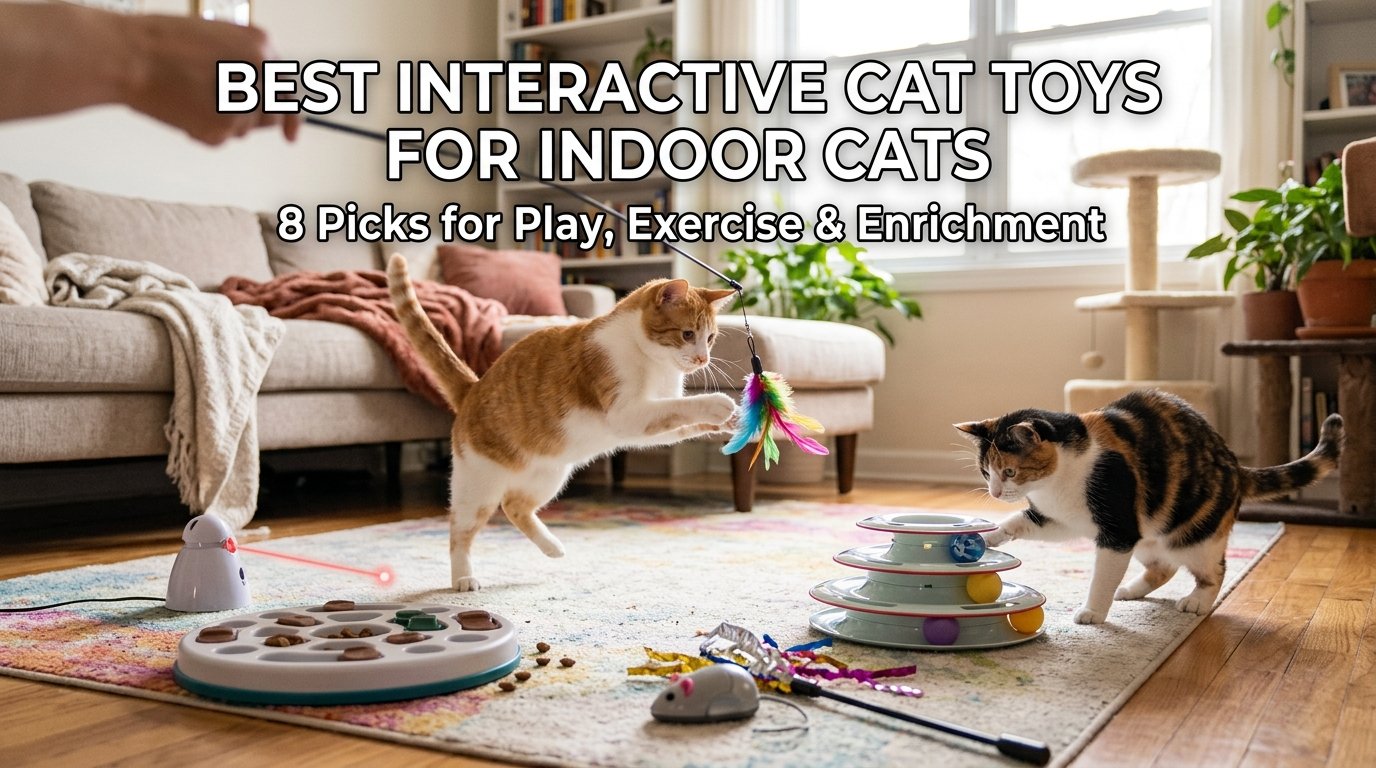
A good cat toy can be much more than something your cat bats around the living room.
For cats, play is closely connected to natural behaviors such as stalking, chasing, pouncing, swatting, grabbing, and manipulating objects. The right toys give indoor cats an appropriate outlet for these behaviors while providing physical activity and mental enrichment.
But choosing a cat toy isn’t always straightforward.
Walk into a pet store or browse an online marketplace and you’ll find hundreds of options: feather wands, balls, tunnels, catnip mice, kicker toys, electronic toys, puzzle feeders, laser pointers, plush toys, and countless products claiming to be “interactive” or “indestructible.”
The problem is that there is no single best cat toy for every cat.
A playful kitten may spend hours chasing a wand toy, while a senior cat may prefer a soft kicker toy that can be reached without jumping. An indoor cat that becomes bored easily may benefit from puzzle feeders and short interactive play sessions. A cat that loves to stalk may prefer toys that move like prey.
Veterinary feline guidelines emphasize providing appropriate environmental enrichment and play opportunities throughout a cat’s life. For kittens, toys can provide an outlet for predatory play behaviors, while food puzzles and foraging toys can add both mental and physical activity.
This cat toy guide explains the major types of cat toys, how to choose them according to your cat’s age and personality, and the safety factors you should consider before buying.
Quick Answer From Our Cat Toy Guide: What Are the Best Cat Toys?
The best cat toy is one that matches your cat’s age, personality, preferred play style, physical abilities, and safety needs.
For most households, a useful toy collection can include:
- Wand toys for interactive hunting-style play
- Small chase toys for batting and pouncing
- Kicker toys for grabbing and kicking
- Puzzle or food toys for mental enrichment
- Catnip or silvervine toys for cats that respond to them
- Tunnels and interactive objects for exploration
- Soft toys for carrying, wrestling, or quiet play
Cats differ considerably in what they find rewarding, so offering several types and rotating them can help prevent boredom.
Why Do Cats Need Toys?
Cats don’t need toys simply because they’re entertaining.
Play provides opportunities for cats to express normal behaviors that might otherwise have limited outlets inside the home.
The AAFP and ISFM environmental-needs guidelines specifically describe play as a way to provide exercise and mimic aspects of predatory behavior. Recommended enrichment includes wand toys, toys that can be manipulated with the paws or mouth, food-containing toys, hiding toys, and rotating toys to reduce habituation.
For indoor cats in particular, enrichment is important because the home environment may provide fewer opportunities for natural exploration and hunting behaviors.
Benefits of Cat Toys
1. Physical Activity
Chasing, pouncing, jumping, swatting, and batting can encourage movement.
Regular opportunities for activity are particularly valuable for indoor cats, whose environment may otherwise encourage a sedentary lifestyle.
The AAHA/AAFP guidelines note that declining play activity can increase susceptibility to weight gain.
However, toys should complement—not replace—an overall healthy lifestyle and appropriate feeding routine.
2. Mental Stimulation
Some toys require cats to investigate, manipulate, search, or solve a simple problem.
Examples include:
- Food puzzles
- Treat-dispensing toys
- Hide-and-seek toys
- Puzzle boxes
- Toys hidden around the home
These activities can make ordinary routines more engaging.
3. An Outlet for Predatory Play
Cats naturally perform behaviors associated with hunting, including:
Observe → stalk → chase → pounce → catch → manipulate
Interactive toys can reproduce portions of this sequence.
A wand toy moved along the floor, for example, can encourage stalking and chasing before allowing the cat to catch the toy.
The goal isn’t to make play stressful or frustrating. Letting the cat successfully capture the toy can make the interaction more satisfying.
4. Helps Prevent Boredom
A cat surrounded by toys isn’t necessarily an enriched cat.
If the same objects remain on the floor every day, your cat may eventually ignore them.
Instead, rotate toys.
Keep some toys stored away and periodically reintroduce them. Feline environmental guidelines specifically recommend rotating toys to help prevent habituation and boredom.
5. Supports the Human-Cat Bond
Interactive play gives you an opportunity to engage with your cat without forcing physical contact.
A wand toy allows you to participate while allowing your cat to control the distance and intensity of the interaction.
This can be particularly useful for cats that enjoy play more than being picked up or cuddled.
Understanding How Cats Play
Before buying toys, consider how your cat actually likes to play.
Different cats may prefer different parts of the predatory sequence.
The Chaser
This cat loves movement.
They may chase:
- Wand toys
- Balls
- Moving toys
- Feather toys
The Pouncer
This cat waits, watches, and suddenly attacks.
They may enjoy:
- Wand toys
- Tunnels
- Toys that disappear behind objects
- Toys dragged across the floor
The Wrestler
This cat likes grabbing objects with the front paws and kicking with the back legs.
Kicker toys and appropriately sized soft toys may be attractive options.
The Food Hunter
This cat is highly motivated by food.
Food puzzles and foraging toys can turn part of mealtime into an enrichment activity.
The Bat-and-Watch Cat
Some cats prefer sitting nearby and batting objects rather than running after them.
Lightweight balls, track toys, and small movable toys may work well.
Types of Cat Toys
There is no need to buy every type available.
Instead, understand what each category is designed to do and choose according to your cat’s preferences.
1. Wand and Teaser Toys
Wand toys have a handle with a flexible attachment such as:
- Feathers
- Fabric strips
- Fleece
- Fur-like material
- Small plush objects
They are among the most useful toys for interactive play because you control the movement.
How to Use Them
Don’t simply wave the toy rapidly in front of your cat’s face.
Instead, try movements that resemble prey:
- Move it slowly along the floor.
- Hide it behind furniture.
- Pause briefly.
- Make it move away from the cat.
- Allow your cat to stalk.
- Let your cat catch it periodically.
Feline environmental guidelines specifically describe wand play that mimics flying or ground prey and recommend allowing the cat to catch the toy.
Safety
Never leave string, ribbon, feather attachments, or similar wand toys accessible to your cat without supervision.
Store interactive wand toys away after play.
2. Small Chase and Batting Toys
Small lightweight toys encourage cats to:
- Bat
- Chase
- Pounce
- Carry
- Toss
Examples include:
- Toy mice
- Lightweight balls
- Small fabric toys
- Crinkle toys
These can be particularly useful for cats that enjoy independent play.
However, choose an appropriate size and regularly inspect toys for loose components.
3. Kicker Toys
Kicker toys are generally longer, soft toys designed for cats to grab with their front paws while kicking with their hind legs.
They can be useful for cats that enjoy wrestling and grabbing during play.
A good kicker toy should be:
- Large enough for comfortable grabbing
- Soft enough to wrestle
- Strongly stitched
- Free from easily detachable parts
4. Puzzle Toys and Food Puzzles
Puzzle toys turn food access into an enrichment activity.
Instead of simply receiving food from a bowl, a cat may need to:
- Bat a compartment
- Move an object
- Search through openings
- Manipulate a toy
- Find hidden food
The AAHA/AAFP feline guidelines specifically recommend introducing food-foraging toys and puzzles for kittens and discussing enrichment, play, and exercise throughout life stages.
Start Simple
Don’t begin with the most difficult puzzle available.
If the cat cannot understand how to access the reward, they may simply walk away.
Start with an easy puzzle and increase difficulty gradually.
5. Catnip Toys
Catnip toys contain or are infused with catnip, which can produce a temporary behavioral response in many—but not all—cats.
Some cats become excited and playful, while others may become relaxed or show little reaction.
Therefore, don’t assume your cat will love catnip.
If your cat doesn’t respond, try another type of enrichment rather than repeatedly buying catnip products.
6. Silvervine Toys
Silvervine is another plant-based enrichment option used in some cat toys.
Some cats that show little interest in catnip may respond to silvervine.
Individual responses vary, so observe your cat rather than assuming a particular ingredient will produce a specific reaction.
7. Electronic and Motion Toys
Electronic toys can move, rotate, vibrate, or otherwise create movement without requiring constant human interaction.
They can provide variety, but they shouldn’t completely replace interactive play with you.
Before buying an electronic toy, consider:
- Battery safety
- Noise level
- Moving parts
- Durability
- Ease of cleaning
- Whether the cat can become frustrated by inaccessible movement
8. Laser Toys
Laser pointers can encourage cats to chase moving light and provide physical activity.
However, a laser dot can never actually be caught.
For that reason, it is better to use laser play thoughtfully and finish the session with an object the cat can physically catch or a food reward.
ever shine a laser directly into a cat’s eyes.
9. Tunnels and Hide-and-Seek Toys
Tunnels provide opportunities for:
- Hiding
- Chasing
- Ambushing
- Exploring
- Resting
They can also become part of interactive games.
A wand toy moving past a tunnel entrance can encourage stalking and pouncing.
10. Plush and Soft Toys
Soft toys can provide opportunities for carrying, biting, wrestling, or quiet independent play.
Choose products with secure stitching and avoid toys that quickly shed filling or have detachable decorations.
A cat that destroys plush toys should be supervised particularly closely.
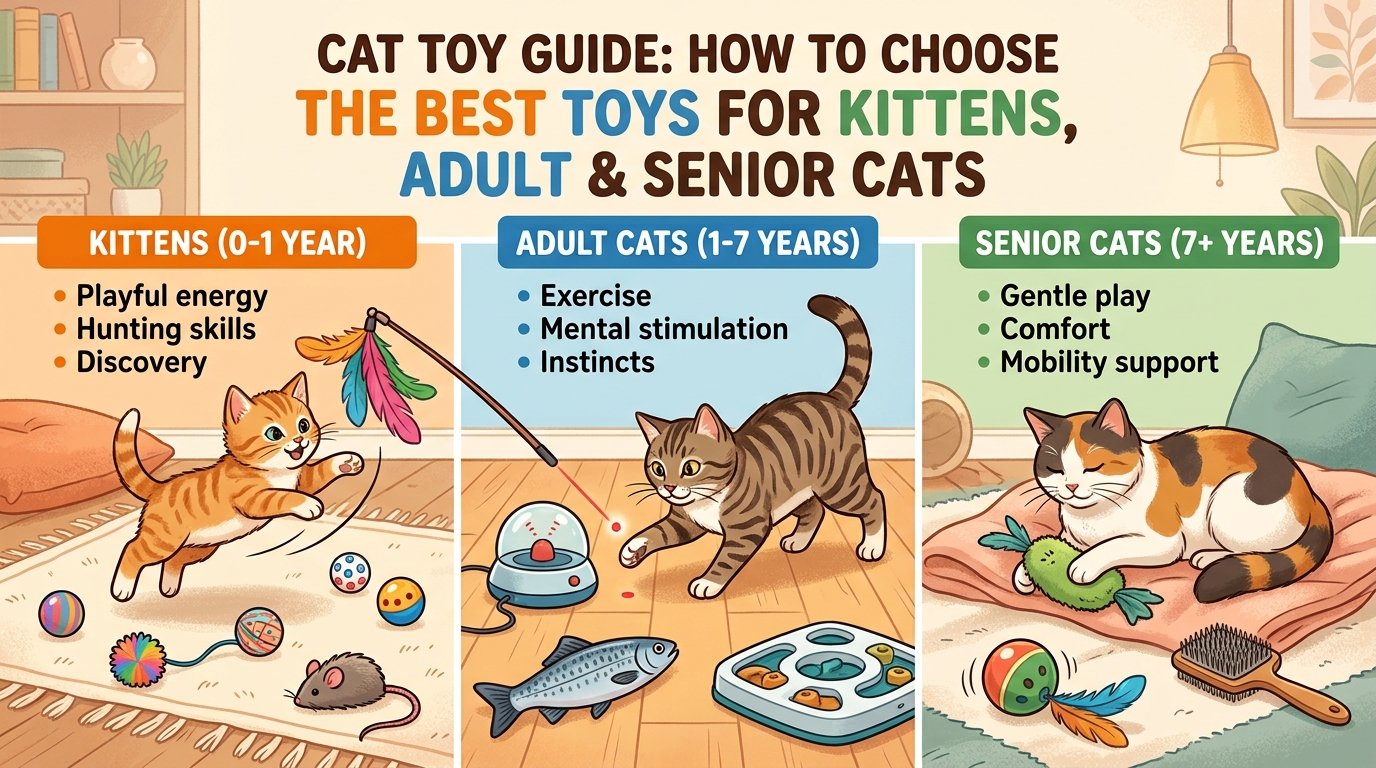
Choosing Cat Toys by Age
Your cat’s age can influence the most appropriate type of play.
Kittens
Kittens generally have a high play drive and learn predatory behaviors through activities such as swatting, chasing, pouncing, and catching. Object play becomes increasingly important as kittens mature.
Good options include:
- Wand toys
- Lightweight chase toys
- Soft kicker toys
- Beginner puzzle toys
- Appropriate interactive toys
Important: Don’t use your hands or feet as toys. Veterinary guidelines specifically recommend avoiding this because kittens can learn that biting and scratching human hands is an acceptable form of play.
Adult Cats
Adult cats can benefit from a mixture of:
- Interactive toys
- Puzzle feeders
- Wand toys
- Chase toys
- Kicker toys
- Food-foraging toys
Don’t assume an adult cat has “outgrown” play.
Play and enrichment remain important throughout adulthood.
Senior Cats
Older cats may continue to enjoy play, but their physical abilities and preferences can change.
Choose activities that don’t require excessive jumping or sudden twisting if your cat has mobility limitations.
Potentially useful options include:
- Ground-level wand play
- Soft kicker toys
- Easy food puzzles
- Lightweight toys
- Gentle interactive play
The AAHA/AAFP guidelines emphasize that environmental needs change with age and that senior cats may need easier access to important resources.
If an older cat suddenly stops playing, becomes reluctant to jump, or shows a significant behavior change, don’t automatically assume it’s simply aging. New behavioral changes can sometimes be associated with pain or medical problems and warrant veterinary evaluation.
Choosing Toys for Indoor Cats
Indoor cats can particularly benefit from environmental enrichment because they may have fewer opportunities to engage in natural hunting and exploration.
Consider providing a combination of:
- Interactive play
- Food puzzles
- Scratching opportunities
- Hiding areas
- Elevated resting spaces
- Rotated toys
The goal isn’t to fill the house with toys. It is to create an environment where your cat has opportunities to play, explore, hunt, rest, scratch, and choose how to interact.
Cat Toy Safety: What Every Owner Should Know
No cat toy should be considered completely risk-free.
Before giving your cat a toy, check:
Size
Avoid toys small enough to be swallowed.
Construction
Look for secure stitching and firmly attached components.
Strings and Ribbons
String-like materials can create serious risks if swallowed. Don’t leave string, ribbon, yarn, or similar toys unattended with a cat.
Feathers and Small Parts
Inspect toys frequently for detached pieces.
Damage
Discard toys that become:
- Torn
- Frayed
- Broken
- Sharp
- Missing pieces
Supervision
Interactive toys with strings, wires, feathers, or detachable components should be used under supervision and stored safely afterward.
Best Cat Toys for Kittens
Kittens have enormous curiosity and energy, and play is an important way for them to practice behaviors such as stalking, chasing, pouncing, grabbing, and batting.
The best kitten toys should be appropriately sized, lightweight, durable, and easy to manipulate.
Good Choices for Kittens
- Interactive wand toys used under supervision
- Lightweight balls
- Soft kicker toys
- Small plush toys without detachable parts
- Beginner puzzle feeders
- Cat tunnels
- Crinkle toys designed specifically for cats
Avoid giving kittens toys that are too large, excessively heavy, or made with easily detached pieces.
A Important Kitten Safety Rule
Don’t use your fingers, hands, or feet as play objects.
Although it may seem cute when a kitten attacks your hand, this can teach the kitten that human skin is an appropriate target for biting and scratching.
Instead, redirect the behavior toward a suitable toy.
Best Cat Toys for Indoor Cats
Indoor cats can have fewer opportunities to engage in natural behaviors such as hunting, exploring, and searching for food.
That doesn’t mean every indoor cat needs dozens of toys.
A better approach is to provide different forms of enrichment and rotate them.
A useful indoor-cat toy collection might include:
| Toy Type | Main Purpose |
|---|---|
| Wand toy | Interactive hunting-style play |
| Puzzle feeder | Mental stimulation and foraging |
| Ball | Chasing and batting |
| Kicker | Wrestling and kicking |
| Tunnel | Hiding and ambushing |
| Catnip toy | Optional sensory enrichment |
| Food toy | Foraging and slower eating |
The goal is to create opportunities for your cat to choose, explore, chase, manipulate, and rest.
Best Toys for Bored Cats
Boredom doesn’t always look like a cat sitting sadly in a corner.
A bored cat may instead:
- Become destructive
- Vocalize excessively
- Pester people
- Knock objects from surfaces
- Overeat
- Sleep excessively
- Seek constant attention
However, these behaviors can also have medical or behavioral causes, so don’t automatically assume boredom is responsible for a sudden change.
For a healthy cat that simply needs more enrichment, consider:
1. Puzzle Feeders
Use part of your cat’s normal daily food allowance in a puzzle feeder.
2. Wand Play
Create short interactive hunting-style sessions.
3. Toy Rotation
Put some toys away and reintroduce them later.
4. Hide-and-Seek
Hide appropriate toys or small portions of food in safe locations for your cat to discover.
5. Tunnels
Use tunnels to create opportunities for hiding and ambushing.
Best Toys for Active Cats
Some cats seem to have endless energy.
These cats may benefit from toys that encourage movement rather than simply sitting and batting at an object.
Consider:
- Wand toys
- Chase toys
- Tunnels
- Motion toys
- Food puzzles
- Fetch-style toys
Make Interactive Play More Interesting
Rather than moving a wand continuously, imitate prey behavior.
Try:
Hide → pause → move → stop → chase → catch
Allow your cat to catch the toy regularly.
This can make play more satisfying than constantly keeping the toy just out of reach.
Best Toys for Senior Cats
Senior cats don’t necessarily stop enjoying play. Instead, their preferred style may change.
A senior cat with reduced mobility may prefer toys that remain close to the floor.
Try:
- Soft wand toys
- Lightweight balls
- Easy food puzzles
- Soft kicker toys
- Low-effort interactive toys
Avoid forcing a senior cat to jump, sprint, or make sudden movements.
If your older cat suddenly loses interest in play, becomes reluctant to jump, or seems painful when moving, speak with a veterinarian rather than simply buying different toys.
Interactive Cat Toys
Interactive toys require your cat to actively participate.
They can include:
- Wand toys
- Treat puzzles
- Food-dispensing toys
- Motion toys
- Track toys
- Electronic toys
Interactive play is particularly useful because it gives your cat an opportunity to make choices and engage with the environment.
Puzzle Feeders: A Toy and a Meal in One
Puzzle feeders can turn mealtime into an enrichment activity.
Instead of receiving the entire meal in a conventional bowl, a portion of the cat’s food can be placed inside a puzzle or food-dispensing device.
The cat may need to:
- Push an object
- Bat a compartment
- Roll a dispenser
- Search for hidden food
- Manipulate openings
Start With an Easy Puzzle
One common mistake is choosing a difficult puzzle immediately.
If the cat can’t figure it out, frustration may replace enrichment.
Start easy and gradually increase the challenge.
Wand Toys: One of the Most Versatile Options
Wand toys are particularly useful because the owner controls the movement.
You can make the toy:
- Crawl along the floor
- Hide behind a chair
- Move around a corner
- Pause underneath furniture
- Suddenly move away
This gives your cat opportunities to stalk and chase.
Important Safety Rule
Don’t leave a wand toy with string, ribbon, elastic, or detachable attachments lying around.
Interactive wand toys should be put away after the play session.
Catnip Toys
Catnip can produce different responses in different cats.
A cat may:
- Become playful
- Rub against the toy
- Roll around
- Become relaxed
- Show little or no reaction
Therefore, catnip isn’t a guaranteed way to make a cat play.
If your cat ignores catnip, try other enrichment options rather than assuming they don’t like toys.
Silvervine Toys
Silvervine is another botanical enrichment ingredient found in some cat products.
Some cats that don’t respond strongly to catnip may show interest in silvervine.
Again, individual responses vary.
The best approach is to observe your cat’s reaction and discontinue any product that causes an undesirable response.
Laser Toys: Are They Good for Cats?
Laser toys can encourage chasing and movement, but they require thoughtful use.
The major limitation is simple:
Your cat cannot physically catch the light.
Because predatory play naturally involves catching and manipulating an object, endlessly chasing an impossible target may be frustrating for some cats.
Safer Laser-Play Approach
If you use a laser:
- Keep the beam away from your cat’s eyes.
- Avoid shining it on people or reflective surfaces.
- Use short play sessions.
- Don’t force your cat to chase continuously.
- Finish with a toy your cat can physically catch or another rewarding activity.
Never use a laser as a substitute for all other forms of interactive play.
Food-Dispensing Cat Toys
Food-dispensing toys can be especially useful for cats that enjoy searching for food.
They can help transform part of a daily meal into an enrichment activity.
Use your cat’s normal food allowance rather than adding large quantities of extra treats.
For cats eating wet food, choose products specifically designed for that texture and clean them carefully after use.
How to Rotate Cat Toys
Leaving every toy available all the time can make individual toys less interesting.
Instead, create a simple rotation system.
Example
Day 1–3
- Wand toy
- Ball
- Puzzle feeder
Day 4–6
- Kicker toy
- Tunnel
- Different chase toy
Day 7
Bring back a previously stored toy.
The exact schedule doesn’t matter as much as providing variety.
You can also observe which toys your cat consistently chooses and prioritize those.
Should Cats Have Toys Available All the Time?
It depends on the toy.
Generally Appropriate for Supervised Independent Play
- Suitable balls
- Secure plush toys
- Appropriate catnip toys
- Some durable batting toys
Better Stored After Play
- Wand toys
- String toys
- Ribbon toys
- Toys with detachable feathers
- Toys containing potentially hazardous small components
When in doubt, supervise play and store the toy afterward.
How Often Should You Replace Cat Toys?
There isn’t a universal replacement schedule because toy lifespan depends on:
- Material
- Construction
- How frequently it’s used
- Your cat’s chewing behavior
- Whether the toy gets wet
- How aggressively your cat plays
Inspect toys regularly.
Replace them immediately if you notice:
- Loose threads
- Detached feathers
- Broken plastic
- Torn seams
- Exposed filling
- Sharp edges
- Missing pieces
- Damaged batteries or electronic components
A toy doesn’t need to look completely destroyed before you replace it.
How to Tell When a Cat Toy Is No Longer Safe
A simple inspection before play can prevent problems.
Ask:
Is anything loose?
Check eyes, bells, feathers, strings, plastic pieces, and other attachments.
Is the material breaking apart?
If your cat can pull pieces off, remove the toy.
Can my cat swallow part of it?
If yes, don’t allow unsupervised access.
Is there a string or ribbon?
Use these only during supervised interactive play and put them away afterward.
Is the toy appropriate for my cat?
Consider size, age, chewing behavior, and physical abilities.
Building a Balanced Cat Toy Collection
You don’t need a huge basket overflowing with toys.
A practical collection can contain a few different categories.
Interactive
1–2 wand toys
For owner-directed play.
Independent Play
2–4 suitable batting or chase toys
For periods when your cat wants to play independently.
Enrichment
1–2 puzzle or food-dispensing toys
For mental stimulation and foraging.
Comfort/Physical Play
1 kicker or soft toy
For wrestling, carrying, or kicking.
Exploration
1 tunnel or similar enrichment item
For hiding, chasing, and exploration.
Rotate them instead of leaving everything available simultaneously.
How to Clean Cat Toys
Cat toys can collect saliva, fur, dust, food residue, and other debris over time. Cleaning them regularly is particularly important for toys used with food.
The correct cleaning method depends on the material.
Rubber and Plastic Toys
For washable rubber or plastic toys:
- Remove visible food and debris.
- Wash with warm water and mild dish soap.
- Use a soft brush to clean grooves and openings.
- Rinse thoroughly.
- Allow the toy to dry completely before returning it to your cat.
Always follow the manufacturer’s cleaning instructions, particularly for electronic toys.
Puzzle and Food-Dispensing Toys
Food toys deserve special attention because leftover food can become a source of contamination.
Clean them after use according to the manufacturer’s instructions.
Pay particular attention to:
- Small openings
- Grooves
- Internal compartments
- Seams
- Areas where wet food can remain trapped
If you cannot clean a food toy thoroughly, reconsider using it with moist food.
Plush and Fabric Toys
Check the care label before washing.
Some fabric toys can be machine washed, while others require hand washing.
Inspect them after cleaning. If stitching has become loose or stuffing is exposed, replace the toy instead of returning it to your cat.
Wand Attachments
Wand attachments can accumulate saliva, dust, and fur.
Inspect them regularly and clean them according to the manufacturer’s recommendations.
If a feather, string, elastic, or attachment becomes loose, discontinue use.
Cat Toys You Should Avoid or Use With Extra Caution
Some toys can present risks depending on how they are constructed or used.
1. Unsupervised String and Ribbon
String, yarn, thread, ribbon, and similar materials can be particularly dangerous if swallowed.
Cats can be attracted to these objects because they move like prey, but swallowing them can cause serious gastrointestinal problems.
Never allow your cat to play unsupervised with loose string-like materials.
Store them securely after play.
2. Toys With Small Detachable Parts
Avoid toys with components that your cat can easily remove and swallow.
Pay particular attention to:
- Small plastic pieces
- Bells
- Eyes
- Feathers
- Rubber components
- Decorative attachments
3. Damaged Toys
A toy that was safe when new may become unsafe after repeated use.
Discard toys that develop:
- Sharp edges
- Cracks
- Loose seams
- Exposed filling
- Detached pieces
- Broken components
4. Toys That Are Too Small
A toy should be appropriately sized for the individual cat.
If your cat can fit the entire toy into their mouth or potentially swallow it, choose a larger alternative.
What About Laser Pointers?
Laser pointers can be used as an occasional interactive activity, but they shouldn’t be the only form of play.
Never:
- Shine a laser into your cat’s eyes.
- Direct it toward reflective surfaces.
- Use it close to your cat’s face.
- Force your cat to chase it for prolonged periods.
A useful strategy is to transition from laser play to a physical toy that your cat can catch.
This gives the cat a tangible object to manipulate at the end of the play session.
Common Cat Toy Buying Mistakes
Buying more toys isn’t necessarily the solution when a cat doesn’t play.
Here are some common mistakes to avoid.
Buying Based Only on Human Preferences
A beautiful plush toy may look fantastic to you but be completely uninteresting to your cat.
Observe what your cat already enjoys.
Does your cat chase movement?
Does your cat prefer batting?
Does your cat enjoy wrestling?
Does food motivate them?
Use those observations when choosing toys.
Buying Too Many Toys at Once
You don’t need to purchase ten different toys to determine what your cat likes.
Start with several different categories and observe the response.
Then invest more heavily in the types your cat actually uses.
Choosing the Most Difficult Puzzle
A complicated food puzzle isn’t necessarily better.
Start with an easy challenge and increase difficulty gradually.
Ignoring Toy Size
A toy designed for a large cat may be awkward for a small kitten, while a tiny toy may create a swallowing hazard.
Always check the manufacturer’s size recommendations.
Assuming “Indestructible” Means Safe
No toy is truly indestructible for every cat.
Even a durable product can eventually crack, tear, or lose components.
Regular inspection is essential.
Best Cat Toy Categories for Amazon Shopping
If you’re building a cat-toy collection through Amazon or another reputable retailer, focus on categories that solve a specific problem rather than buying products simply because they’re popular.
For Interactive Play
Look for:
- Wand toys
- Teaser toys
- Interactive chase toys
For Mental Stimulation
Consider:
- Puzzle feeders
- Treat-dispensing toys
- Food-foraging toys
For Indoor Cats
Look for:
- Tunnels
- Interactive toys
- Chase toys
- Kicker toys
- Enrichment toys
For Kittens
Prioritize:
- Kitten-safe wand toys
- Lightweight toys
- Soft toys
- Beginner puzzles
For Senior Cats
Consider:
- Lightweight toys
- Low-impact interactive toys
- Soft kicker toys
- Easy-access food puzzles
For Cats That Love Catnip
Consider:
- Catnip mice
- Catnip kicker toys
- Catnip plush toys
Remember that product selection should always consider size, construction, supervision requirements, and your cat’s individual play style.
Frequently Asked Questions
What is the best toy for an indoor cat?
There isn’t one universally best toy. A combination of interactive wand toys, chase toys, food puzzles, and other enrichment options can provide different forms of stimulation.
The best choice depends on what your individual cat enjoys.
How many toys should a cat have?
There is no required number.
A small collection containing several different types of toys can be sufficient if you rotate them and provide regular opportunities for interactive play.
How often should I play with my cat?
There is no single schedule that works for every cat.
Many cats benefit from several short interactive sessions throughout the day rather than one very long session.
Adjust the intensity and duration to your cat’s age, health, personality, and interest.
Are laser pointers safe for cats?
Laser pointers can be used carefully, but never shine the beam into the eyes. Because cats cannot physically catch the light, it is useful to finish the session with a tangible toy or another rewarding activity.
Can cats play with string?
String-like toys can be attractive to cats but should only be used under direct supervision.
Never leave string, yarn, ribbon, or similar materials available for unsupervised play because swallowing them can cause serious complications.
Do all cats like catnip?
No.
Some cats respond strongly to catnip, while others show little or no response. A lack of interest in catnip doesn’t mean your cat doesn’t enjoy play.
Are electronic cat toys worth buying?
They can provide variety and independent enrichment for some cats, but they shouldn’t replace interactive play with their owner.
Choose products with secure battery compartments and inspect moving parts regularly.
Why does my cat suddenly stop playing with toys?
A cat may lose interest because of habituation, stress, environmental changes, or simply because the toy has become predictable.
However, a sudden or significant reduction in play—particularly when accompanied by changes in appetite, movement, grooming, litter-box behavior, or social interaction—can indicate a health problem.
Consult your veterinarian if you’re concerned.
Trusted Veterinary and Animal-Welfare References
For further reading, consult resources from organizations and institutions such as:
- American Association of Feline Practitioners (AAFP)
- American Animal Hospital Association (AAHA)
- American Veterinary Medical Association (AVMA)
- World Small Animal Veterinary Association (WSAVA)
- Merck Veterinary Manual
- Cornell University College of Veterinary Medicine
- International Association of Animal Behavior Consultants (IAABC)
These resources can provide additional information about feline behavior, nutrition, preventive care, and environmental enrichment.
Cat Nutrition
Ultimate Cat Food Guide: How to Choose the Best Food for a Healthy, Happy Cat
Cat Feeding
Cat Food Comparison
Cat Behavior
Why Does My Cat Follow Me Everywhere?
Final Verdict: Which Cat Toys Should You Buy?
The best cat toy isn’t necessarily the most expensive, most popular, or most technologically advanced option.
It’s the toy that gives your cat an appropriate opportunity to play, explore, chase, manipulate, forage, or interact while remaining safe for their individual size and abilities.
A balanced collection can include:
- A wand toy for interactive hunting-style play
- A few appropriate chase or batting toys
- A kicker toy
- A puzzle or food-foraging toy
- A tunnel or hiding option
- An optional catnip or silvervine toy if your cat responds to it
Most importantly, rotate toys instead of leaving everything available all the time. Supervise toys that contain strings, ribbons, feathers, batteries, or detachable parts, and replace anything that becomes damaged.
If your cat suddenly stops playing, don’t simply assume they are bored or getting older. A significant change in behavior can sometimes indicate pain, illness, or another underlying problem.
The best cat-toy strategy is therefore simple: observe your cat, offer variety, encourage natural play behaviors, prioritize safety, and adapt enrichment as your cat’s needs change.
How We Researched This Guide
This guide was developed using veterinary and feline-care resources rather than relying solely on product marketing claims.
We reviewed information relating to:
- Feline environmental enrichment
- Normal play behavior
- Predatory behavior
- Food puzzles and foraging
- Kitten development
- Senior-cat environmental needs
- Toy safety
- Indoor-cat enrichment
- Interactive play
The goal is to help cat owners make practical decisions based on their individual cat rather than promoting a single toy or manufacturer.
Editorial Disclaimer
This article is intended for general educational purposes and does not replace individualized veterinary or behavioral advice.
Cats have different physical abilities, play preferences, and health needs. Always supervise your cat when introducing a new toy, particularly toys containing string, ribbon, feathers, small parts, batteries, or other potentially hazardous components.
If your cat swallows part of a toy or string-like object, develops difficulty breathing, vomits repeatedly, stops eating, or shows other concerning symptoms, contact a veterinarian promptly.