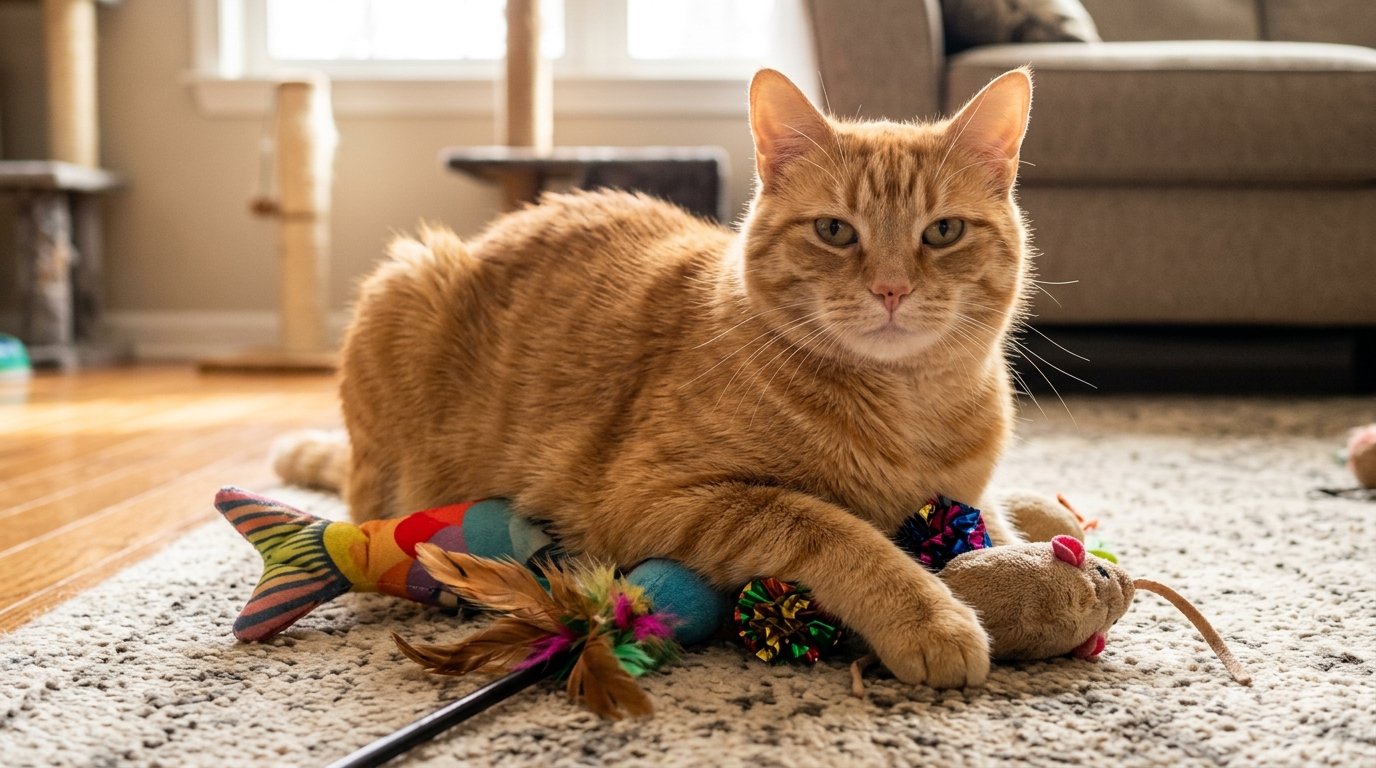
Have you ever bought your cat a brand-new toy, watched them play with it for five minutes, and then found them sitting directly on it? It is one of those funny cat behaviors that makes you wonder what is actually going through their mind.
Maybe your cat is protecting the toy. Maybe they are claiming it. Maybe it simply happens to be the most comfortable thing on the floor. Or, as every cat owner eventually learns, your cat may have absolutely no interest in explaining themselves.
So, why do cats sit on their toys?
There isn’t one definite answer. Cats may sit on toys for several different reasons, and the meaning can depend on what your cat does before and after sitting on the toy. Veterinary-reviewed sources suggest possibilities including resource guarding, prey-related behavior, comfort, scent, attention, and individual personality.
Let’s look at the most likely explanations.
Quick Answer: Why Do Cats Sit on Their Toys?
Cats may sit on their toys because:
- The toy is comfortable
- They want to keep the toy close
- They may be treating it like prey
- The toy has their scent or your scent
- They have learned it gets your attention
- They may be guarding a favorite toy
- They are resting after playing
- They simply like the texture or position
- It has become part of their routine
- They have a quirky individual preference
The important thing is to look at the whole behavior, rather than assuming that sitting on a toy always means the same thing.
1. Your Cat May Be Protecting the Toy
One possibility is that your cat considers the toy valuable.
This becomes particularly interesting in homes with multiple cats.
If your cat sits on a toy whenever another cat approaches, carries it away, or becomes tense when another cat tries to take it, they may be trying to control access to something they consider valuable.
Resource guarding can involve toys as well as other resources, particularly when several pets share the same home.
But don’t automatically assume your cat is being aggressive.
A cat quietly lying on a toy is very different from a cat hissing, swatting, chasing another cat away, or becoming tense whenever someone approaches.
What to watch for
Pay attention to what happens when another pet comes near.
If your cat simply stays there, it may just be a preferred resting place.
If they repeatedly prevent another cat from accessing the toy, resource guarding may be part of the picture.
2. Your Cat May Be Treating the Toy Like Prey
This one makes a lot of sense when you understand how cats play.
Cats naturally stalk, chase, pounce on, grab, and manipulate objects. Toys allow indoor cats to express some of these normal hunting behaviors.
After chasing a toy around the room, your cat may grab it and settle on top of it.
To us, it looks like:
“Why are you sitting on your toy?”
To your cat, the sequence may simply be part of an enjoyable play routine.
Some veterinary-reviewed explanations describe cats sitting on toys as potentially related to prey-like behavior, particularly when the cat has been actively chasing, batting, biting, or carrying the toy beforehand.
3. The Toy May Simply Be Comfortable
Sometimes there is no complicated explanation.
Your cat may just think the toy is comfortable.
Soft plush toys can create a slightly cushioned surface, especially when they’re lying on a hard floor.
And cats are experts at finding unusual places to rest.
They sit on:
- Boxes
- Laundry
- Blankets
- Bags
- Books
- Clothing
- Your laptop
- Empty chairs
- And apparently their own toys
Soft and warm surfaces are particularly attractive resting places for cats.
So if your cat calmly climbs onto a soft toy and takes a nap, comfort may be all there is to it.
4. The Toy May Smell Familiar
Scent is extremely important to cats.
They use smell as part of how they understand and interact with their environment, and familiar scents can be reassuring.
If you regularly handle your cat’s toy, your scent can become associated with it.
Your cat may therefore return to that object because it smells familiar.
This is similar to why some cats like sleeping on clothing that smells like their favorite person.
So that toy sitting in the corner may not be just a toy anymore.
It may be one of the familiar-smelling objects in your cat’s environment.
5. Your Cat May Be Leaving Their Own Scent
Cats also interact with their environment through scent marking.
They have scent glands around parts of their face and body, and rubbing against objects can help transfer their scent.
That doesn’t necessarily mean that every cat sitting on a toy is deliberately marking it. The evidence doesn’t support such a simple explanation.
But scent and familiarity can influence which objects cats choose to interact with.
So if your cat repeatedly returns to the same toy, scent may be one small part of the reason.
6. Your Cat May Have Learned That You React
Now comes the funny possibility.
Maybe you taught them to do it without realizing it.
Imagine this:
Your cat sits on a toy.
You laugh.
You take a picture.
You call their name.
You pet them.
You say, “What are you doing?”
From your cat’s perspective, sitting on that toy just produced an interesting result: attention from you.
Cats can learn that certain behaviors lead to attention or interaction. Veterinary-reviewed explanations of this behavior include attention-seeking as one possible reason cats repeatedly sit on toys or other unusual objects.
So yes, your cat may eventually realize:
“When I sit here, my human pays attention to me.”
And then they do it again.
7. They May Simply Be Resting After Play
Sometimes the answer is even simpler.
Your cat was playing.
They chased the toy.
They batted it around.
They pounced on it.
Then they got tired.
So they sat down.
Unfortunately for your cat, the toy happened to be underneath them.
Cats don’t always seem particularly concerned about whether their resting spot makes sense to us.
If your cat looks relaxed, isn’t guarding the toy, and eventually gets up and moves on normally, there’s usually no reason to make the behavior into something more complicated.
8. Your Cat May Simply Like That Particular Toy
Cats can be surprisingly selective.
You might spend money on a fancy electronic toy only to discover that your cat’s favorite object is a small fabric mouse that cost almost nothing.
This isn’t unusual.
Cats can have individual preferences for different toy types, textures, movement patterns, and play styles. Veterinary guidance recommends offering variety and rotating toys rather than leaving every toy available all the time.
If your cat repeatedly chooses one particular toy, pay attention.
They may be telling you what they like.
Why Do Cats Sit on Toys Instead of Playing With Them?
This is where cat behavior becomes particularly funny.
You may have watched your cat ignore a toy for days, only to suddenly sit on it.
That doesn’t necessarily mean they’ve stopped enjoying it.
Cats don’t need to interact with every toy in the same way.
One toy might be interesting to chase.
Another might be interesting to carry.
Another might be something they bat around.
And another might simply become their preferred resting object.
A 2025 study examining cats’ interaction with toys found that cats interacted more with moving toys than stationary ones, while adding preferred odors increased interaction with stationary toys. This supports the broader idea that movement and sensory characteristics can influence how cats use toys.
Your Cat’s Personality May Be the Whole Explanation
Sometimes the most honest answer is:
Because your cat is your cat.
Not every feline behavior has to have a dramatic explanation.
Some cats sleep inside boxes.
Some carry toys around.
Some drop toys into their owner’s shoes.
Some sit on everything.
And some seem determined to make the least comfortable object in the house their favorite place.
Individual personality can play a role in how cats interact with toys and their surroundings.
How to Tell What Your Cat’s Toy-Sitting Means
Instead of looking only at the sitting itself, look at what happens before and after.
If your cat plays first…
They may be treating the toy as part of a hunting or play sequence.
If your cat carries the toy away…
They may simply prefer to play or rest with it somewhere else.
If your cat sits on it when another cat approaches…
Resource guarding may be involved.
If your cat falls asleep on it…
Comfort is a likely explanation.
If your cat looks at you afterward…
They may have discovered that this behavior gets your attention.
If your cat sits on many different objects…
It may simply be their personal habit.
Context is much more useful than trying to assign one meaning to the behavior.
Should You Stop Your Cat From Sitting on Their Toys?
Usually, there is no reason to stop a cat from simply sitting or lying on a toy if they are comfortable and the toy is safe.
In fact, letting cats interact with toys in different ways can be part of healthy enrichment.
Cats need opportunities for normal behaviors such as play, exploration, hunting-related activities, climbing, and scratching.
The bigger question is whether the toy itself is safe.
How to Choose Safe Toys for Cats
Not every cute cat toy is automatically safe.
Cornell’s feline health guidance recommends avoiding toys with small pieces or string-like parts that could separate and be swallowed. It also recommends considering the environment where your cat plays.
Look for toys that:
- Are appropriate for your cat’s size
- Don’t have easily detachable pieces
- Don’t have loose strings that your cat can swallow
- Can withstand normal play
- Don’t contain accessible electrical cords
- Are checked regularly for damage
Supervise your cat with unfamiliar toys, particularly toys containing strings, feathers, ribbons, or small components.
If your cat begins chewing pieces off a toy, take it away.
An Interactive Cat Toy
If your cat has a habit of sitting on toys because they lose interest quickly, adding some variety to playtime may help.
Catpick Joy 360° Automatic Spin Flying Bird Wand is one type of interactive toy to consider for cats that enjoy movement and chasing. Interactive toys can give indoor cats another opportunity to stalk, chase, and pounce, which are natural behaviors.
I would introduce any new interactive toy while watching how your cat responds. Some cats love moving toys immediately, while others prefer simple balls, plush toys, or objects they can bat around themselves.
Don’t Give Your Cat Too Many Toys at Once
More toys don’t necessarily mean more entertainment.
In fact, rotating toys can help prevent cats from becoming bored with the same objects.
Veterinary guidance suggests keeping a larger assortment available but offering only a smaller selection at a time, then rotating them to create novelty.
For example, you could leave out:
- One plush toy
- One ball
- One interactive toy
- One scratching option
Then change the selection every few days.
You may be surprised when an old toy suddenly becomes interesting again.
If you’re looking for more ways to keep an indoor cat active, check out my guide to interactive cat toys for indoor cats.
When Should You Be Concerned?
Simply sitting on a toy is generally not a reason to worry.
However, pay attention if the behavior is part of a sudden or broader change in your cat’s behavior.
For example, contact your veterinarian if you notice other concerning changes such as:
- Sudden aggression
- Significant withdrawal
- Loss of appetite
- Pain when touched
- Difficulty moving
- Unusual vocalization
- Major changes in sleeping or eating
- Other new behaviors that concern you
A single quirky habit is very different from a sudden change accompanied by other signs of illness or distress.
If your cat also seems to follow you from room to room, you may enjoy reading why cats follow you everywhere.
FAQs
Why does my cat sit on their favorite toy?
Your cat may be keeping the toy close, treating it as a valuable object, using it as a comfortable resting spot, or simply enjoying its texture. If they play with the toy before sitting on it, prey-related play behavior may also be involved.
Why does my cat sit on their toys and stare at me?
They may have learned that sitting on the toy gets your attention. Cats can repeat behaviors that produce an interesting response from their owners.
Why does my cat sleep on their toys?
The toy may simply be comfortable, soft, warm, or familiar-smelling. If your cat is relaxed while doing it, they may simply have found another favorite resting spot.
Why does my cat sit on a toy when another cat comes near?
In a multi-cat household, the behavior could potentially be related to guarding access to the toy. Watch for other signs such as blocking, hissing, swatting, or chasing.
Is it normal for cats to sit on toys?
Yes, it can be a completely normal quirky behavior. Cats interact with toys in many different ways, including carrying, batting, biting, chasing, resting on, and hiding them.
Should I take the toy away?
Only if the toy becomes damaged or contains pieces that could be swallowed. Otherwise, there is generally no need to stop your cat from sitting on a safe toy.
Do cats think their toys are real prey?
Some toys can trigger hunting-related behaviors because cats naturally stalk, chase, pounce on, and capture moving objects. But we shouldn’t assume that every cat literally believes a toy is a real animal.
Final Thoughts
So, why do cats sit on their toys?
Sometimes they’re protecting them.
Sometimes they’re playing.
Sometimes they’re enjoying the familiar smell.
Sometimes they’re simply tired.
And sometimes your cat has apparently decided that the toy you bought for $20 makes an excellent chair.
That’s part of what makes living with cats so entertaining.
Rather than worrying about every unusual behavior, look at the bigger picture. If your cat is relaxed, eating normally, playing, grooming, and behaving normally otherwise, sitting on a toy may simply be one of those wonderfully strange things that makes your cat unique.
And honestly, if your cat has finally chosen a toy instead of your laptop, I’d call that a win.